• Mini medieval ‘grete pyes’

    Back in November, during the drinks reception ahead of our annual Stenton Lecture, I got chatting to our social media maven, Chessie Baldwin. Talk turned to History’s blog and what we’d be doing as our Christmas series this year … at some point in our conversation I mentioned the possibility making a medieval recipe and ‘tweaking’ it for a twenty-first century Christmas and thus the premise behind this blog post formed. But what to make? Well, why not a medieval great pie, or ‘grete pye’ to give it the Middle English spelling![i]

    This post is not, I should stress early on, is not a ‘history of medieval Christmas’. I have in previous years discussed medieval Christmas celebrations in more detail and am mindful not to replicate myself here. Nor is this post an attempt at providing a cook-a-long for making your own ‘grete pye’. Rather it should be seen as a light read and an encouragement, to all who want to, to have some fun in the kitchen this festive season. With that said, on to the pye!

    John of Gaunt, duke of Lancaster, dines with the king of Portugal (London, British Library, Royal MS 14 E IV, f. 244v).
    John of Gaunt, duke of Lancaster, dines with the king of Portugal (London, British Library, Royal MS 14 E IV, f. 244v).

    Medieval ‘grete pyes’

    A ‘grete pye’ was a staple of a medieval Christmas feast. The specific ingredients could differ depending on maker, availability, personal taste etc., but the key elements were various meats, dried fruits, and spices (I hope the need for pastry goes without saying!)

    The recipe for this version of a ‘grete pye’ was recorded in a mid-fifteenth century cook book (now BL, Harley MS 4016), in the twentieth century it was published in an edition of medieval recipes edited by Thomas Austin, before then being published alongside a modern interpretation in Black’s The Medieval Cookbook, (British Museum Press). The late-medieval recipe can be found below, but I am very grateful to Black for the modernised version which includes measurements and cooking times which meant this was a lot less trial and error.

    Grete pyes. Take faire yonge beef, And suet of a fatte beste, or of Motton, and hak all this on a horde small; And caste thereto pouder of peper and salt; And whan it is small hewen, put hit in a bolle, And medle hem well; then make a faire large Cofyn, and couche som of this stuffur in. Then take Capons, Hennes, Mallardes, Connynges, and parboile hem clene; take wodekokkes, teles, grete briddes, and plom hem in a boiling potte; And then couche al this fowle in the Coffyn, And put in euerych of hem a quantite of pouder of peper and salt. Then take mary, harde yolkes of egges. Dates cutte in ij. peces, reisons of coraunce, prunes, hole clowes, hole maces, Canell, and saffron. But first, whan thou hast cowched all thi foule, ley the remenaunt of thyne other stuffur of beef a-bought hem, as thou thenkest goode; and then strawe on hem this: dates, mary, and reysons, &c. And then close thi Coffyn with a lydde of the same paast, And putte hit in the oven. And late hit bake ynogh ; but be ware, or thou close hit, that there come no saffron nygh the brinkes there-of, for then hit wol neuer close.

    ‘A grete’ pye’, cited in Black, The Medieval Cookbook, p. 118.

    Having looked through the recipe, and Black’s reworking of it, I made the decision to go for chicken and sausage meat as the two meat options. For the dried fruits I went with equal portions of ‘coraunce’ (currants), prunes, dates and apricots – the latter adding a little colour to the mix. I followed Black’s guidance on spices and made up a blend of cinnamon and mace with a pinch of ‘clowes’ (cloves).

    A picture containing the items required in the recipe for a 'grete pye' as per Maggie Black's recipe.

    As for the pie crust itself, I have a confession to make, I used shop-bought pastry! Any bakers reading this are likely tutting at me right now, I know! I would usually make my own shortcrust pastry, but for time and ease this worked well and, after all, the pie ‘coffyn’ was hardly the star of this show.

    In forming the pastry ‘coffyn’, and with Chrisitmas celebrations in mind, I made the choice to move away from the ‘grete’ in size pye for mini ‘grete pyes’ that would be more suitable for party nibbles. Gone are the days of sitting down to a great medieval feast and I wanted to make these pyes a more practical (and hopefully somewhat less messy) festive offering.

    Making the pyes smaller (I used a cupcake tin) also meant adjusting the method. This was not going to be the large pye envisaged either by our fifteenth-century cook or by Black with repeated layers of spiced minced meat, egg yolks and dried fruits, and boiled meats that should bake slowly in the oven. My mini pyes would bake to a crisp if I tried that! Instead, I pre-cooked the filling – ‘parbolie’ (poaching) the chicken as per the recipe before mixing it in with the cooked sausage meat, spices, and fruits. The pastry was then rolled out and the mini pyes shaped, filled, and the ‘coffyn’ lids put on (making sure to give these and egg wash and pierce them to let steam escape). The pyes were then popped in to the over (fan, 200oC) for around 15 minutes until they were cooked through and golden on top.

    Cooks preparing food in the Luttrell Psalter (London, British Library, Add MS 42130, f. 207r).
    Cooks preparing food in the Luttrell Psalter (London, British Library, Add MS 42130, f. 207r).

    The finished product was, I’ll be honest, a little ‘rustic’ looking, and despite piercing the lids and sealing the lid to the base, a few pies did open up while in the oven. However, the smell of the meats and spices cooking definitely had that Christmas feel to them, and for my first attempt at making these I’m pretty pleased. I’ve even got some left-over pie filling to make another batch with.

    As for the taste, I was pleasantly surprised, but a good cook always listens to others too, so I decided to find some taste testers in the History department: Anne Lawrence, Elizabeth Matthew, Jacqui Turner, and Emily West were the lucky (?!) guineapigs. Despite my trepidations, the pyes went down well (so much so I left the remaining pyes with them).

    Will I be adding grete pye(s) to my collection of Christmas recipes in future years? Yes! I’d like to add a few fresh herbs in too just to balance the flavours out but these were surprisingly easy to make and definitely worked well on a ‘mini’ scale making them an excellent option for a festive social gathering and they bring something new (old?) to the table!

    A second picture of mini medieval 'grete pyes' sit on a table

    [i] This blog post was concurrently published on the UoR History blog ‘Reading History’.

  • I am delighted to announce that registration is now open for The Maladies, Miracles and Medicine of the Middle Ages, III ‘Patients, Prayers and Pilgrims’.

    The conference will be run in a hybrid format online and in-person at the University of Reading (UK). Please note that we have limited in-person attendance available, and this will be allocated on a first-come, first-served basis.

    Conference registration will close end-of-day Monday 7 March.

    To register please email the organisers (Dr Ruth Salter, Claire Collins, and Anne Jeavons) via the conference email address: maladies.miracles.medicine@gmail.com.

    Our wonderful programme of speakers can be found below.

    9.00-9.30: Registration

    9.30-9.45: Welcome

    9.45-11.10: Panel 1: Practical and Holistic Healthcare (chair: Anne Jeavons)

    Dr Philippa Byrne (University of Oxford) ‘Bathers and Readers: Healing in Twelfth-Century Pozzuoli and Salerno’

    Diane Budden (University of Winchester) ‘‘For the howse that Brigit kept the Syk people yn’: Comparing Healthcare in Southampton and Portsmouth in the Late Fifteenth and Early Sixteenth Century’

    Heather Taylor (University of Kent) ‘Practitioners of holistic healthcare: magico-medical treatments in the Middle Ages’

    11.10-11.25: Coffee Break

    11.25-12.45: Panel 2: Travel and Healthcare (chair: Dr Katie Phillips)

    Janet Walls (University of Reading) ‘Brontology in the context of the regimen of health and implications for travel’

    Laura Esposito (University of Naples) ‘The health remedies “contra lassitudo” in the medical treatise “De regimine et via itineris et fine peregrinantium” written by Adamo da Cremona (13th century).’

    Maja Perić (University of Zagreb) ‘Being sick, seeing the sick and being healed. How pilgrims from the Low Countries coped with illness during their journey to the Holy Land’

    12.45-13.35: Lunch Break

    13.35-14.55: Panel 3: Devotion and Material Culture (chair: Claire Collins)

    Dr Frances Cook (University of Reading) ‘Representations of Saints Margaret of Antioch and Nicholas of Myra in English parish churches and their role in ensuring the well-being of Christian communities’

    Molly Proud (University of St Andrews) ‘Wax Bodies: How beeswax votives, like Exeter Cathedral’s c. fifteenth century hoard, advocated for the divine healing of their votaries’ bodies’

    Aisling Passmore (University of Oxford) ‘Heavenly Mothers: embodiment, devotion and gender in late medieval childbirth’

    14.55-15.10: Coffee Break

    15.10-16.30: Panel 4: Saints and Medicine (chair: Dr Claire Carrothers)

    Caroline Bourne (University of Reading) ‘The Early Medieval Gower Saints as Healers’

    Jude Seal (Royal Holloway, University of London) ‘Healed Pilgrims and Suffering Saints’

    Dr Ninon Dubourg (University of Liège) ‘Secundum assertionem et consilium medicorum: Petitioners as patients in front of the Apostolic Chancery during the Avignon Period (1309-1378)’

    16.30-16.40: Quick Break

    16.40-17.40: Panel 5: Grief and Trauma (chair: Dr Ruth Salter)

    Lorenz A. Hindrichsen (Copenhagen International School) ‘Postpandemic trauma in Geoffrey Chaucer’s The Franklin’s Tale’

    Dr Emily A. Winkler (University of Oxford) ‘Personality of Pathology? Chronic Grief and Social Intervention in Medieval Thought, c.1050-1200’

    17.40-18.00: Concluding remarks

  • I’m excited to announce that the third quadrennial ‘Maladies, Miracles and Medicine’ (MM&M) conference will be taking place on Friday 1 April 2022. The Call for papers (CFP) can be found below with further details about the conference theme and the submission of abstracts. The image is presented as a .jpg, however a .pdf version is available if required (please email myself and my co-organisers via maladies.miralces.medicine@gmail.com)

    With regards to my co-organisers, I am joined for ‘MM&M3’ by two brilliant PhD researchers based in the Department of History/Graduate Centre for Medieval Studies (GCMS) here at the University of Reading. Claire Collins is currently in the process of finishing her thesis on Middle English midwifery tracts, and Anne Jeavons is part way through her doctoral research into matters of the mind and (what we might today term) ‘mental health’.

    If you would like to submit an abstract and/or have any questions, please don’t hesitate to get in contact with us via the conference email address (see above). We will be sending out further information in early-mid January 2022 regarding finalised conference programme, conference attendance etc.

    Call for Papers for 'The Maladies, Miracles and Medicine of the Middle Ages, III: Patients, Prayers and Pilgrims' (an postgraduate researcher and early career researcher event to be held Spring 2022). 

This image can be made available as a pdf or word doc if required - contact the organisers at maladies.miracles.medicine@gmail.com
  • If you are anything like me you will be thinking that after what felt like a prolonged grey, cold winter it feels like we should’ve turned a corner into summer. I suppose it’s mild at least and that’s almost enough to break out into a rendition of Reading Abbey’s own thirteenth-century composition ‘Sumer is icumen in’ … almost (you’d have to be a better singer than me for that though!).

    Of course, as is always the case with the British weather, there’s no guarantee that it will stay warm, and it’s looking like this summer might be a bit of a washout, if this rain continues! But, what does any of this have to do with St Swithun, Winchester’s saintly ninth-century bishop?

    Swithun (d. 863) was a Winchester churchman through and through, rising to the position of bishop of Winchester in c. 852-4.[1] However, it is his posthumous work, as a saint and miracle worker, that Swithun is best known for. Among various miracles of aiding and healing those who petitioned him for his aid, a curious reputation has become attached to Swithun and his feast day, 15 July – oh, wait, that’s today!

    This superstition is perhaps best summed up in the words of the following Elizabethan poem:

    St Swithin’s day if thou dost rain,

    For forty days it will remain,

    St Swithin’s day if thou be fair,

    For forty days will rain na mair.[2]


    Where does this folkloric tradition come from? Well, the earliest-known textual reference of weather prophecy in relation to Swithun comes from a manuscript now held by Emmanuel College, Cambridge, that dates from the late thirteenth to early fourteenth century.[3] However, the claim is backdated to the translation of Swithun’s tomb in the tenth century. This translation (the moving of a saint’s tomb or reliquary, or the moving of a saint into a new tomb or reliquary) occurred on the anniversary of Swithun’s death, his feast day, 15 July 971.

    George Cruikshank (d. 1878) ‘St Swithun, Patron Saint of Umbrella Makers’, produced 1829[4]

    According to the later texts, the moving of his body from its initial burial place outside the church into Winchester Old Minster was proceeded by a storm that lasted (as the above poem states) for forty days. From this grew a tradition that if it rained on 15 July it would rain for the next six weeks.

    Now, while Swithun is pretty amazing (I’ve always had a soft spot for him), it would be fair to say that this belief sounds like superstition. But, that doesn’t mean that there’s not some truth about the weather patterns between mid-July and the end of August. While I am all for encouraging my students (as well they know!) to understand sources and beliefs within their own time, this is one occasion where a little modern meteorological know-how actually adds to our understanding of this idea…

    St Swithun from Robert Dudley’s Monthly Maxims: Rhymes And Reasons To Suit The Seasons, And Pictures New To Suit Them Too (London, 1882).

    Why? Well, it has to do with the jet stream and its positioning. As meteorologist Derek Brockway (among others) has highlighted, the jet stream’s position in the middle of July can impact on the weather for the remainder of the summer.[5] If it’s north of the UK, then we can expect warmer, drier weather. However, if it’s over the UK this causes low pressure and wetter weather.

    The Met Office on the jet stream[6]

    Although it is unlikely to rain continually for forty days, prolonged wet weather during the summer can feel like it drags on. So, if it rains on St Swithun’s day will it rain until late August? Probably not. But, does this old association with the saint’s feast day and the weather have some grounding in meteorology? Yes.

    So, let’s hope that this year we get good weather on 15 July and that both Swithun and the jet stream permit us a warm, dry summer!

    Forecast for Thursday 15 July 2021 for Reading (UK), via Weather Underground (as of 11am, Monday 12 July 2021) – let’s hope this doesn’t change![7]


    Notes

    This blog post can also be found on ‘Reading History’, the Department of History, University of Reading, blog.

    [1] B. Yorke, ‘Swithun [St Swithun] (d. 863), bishop of Winchester’, Oxford Dictionary of National Biography, 23 Sept. 2004, (accessed 16 June 2021).

    [2] J. Somerladd, ‘St Swithin’s Day 2018: Who was the British saint and why is he associated with the weather?’, Independent, 12 July 2018 (accessed 12 July 2021). NOTE: this article states the poem is twelfth century in origin but I am not aware of this being the case and the use of Middle English would suggest later.

    [3] ‘St. Swithin’s Day’, Encyclopedia Britannica, rev. E. Rodriguz 30 April 2020 (accessed 12 July 2021).

    [4] G. Cruikshank, ‘St. Swithin, Patron Saint of Umbrella Makers, vignette fragment from Plate 6 of Scraps and Sketches, Part II’, Ackland Art Museum (accessed 17 June 2021).

    [5] D. Brockway, ‘St Swithin’s Day’, BBC Wales, 15 July 2009 (accessed 16 June 2021)

    [6] Met Office, ‘What is the jet stream and how does it affect the weather?’, YouTube, 29 May 2018 (accessed 17 June 2021).

    [7] ‘Hourly Forecast for Thursday 07/15’, Weather Underground, as of 11:00 12 July 2021 (accessed 12 July 2021).

  • I am delighted to be able to share the following CfP for the International Medieval Congress, University of Leeds, July 2023.

    Below you will find a copy of the CfP as a jpg image. A text version of the CfP can be found below that too.

    Text version:

    Searching for Health and the Holy: Traces in Texts and Topography

    For IMC 2023: ‘Networks and Entanglements’ (July 2023)

    Sponsors: The Graduate Centre for Medieval Studies/

    Department of History, University of Reading

    Panel Abstract:

    This/these panels seek to consider the ways in which connections could be built, and blurred, and what this meant in terms of understanding and experiencing the saintly and the prophetic. Abstracts are welcomed on any element that connects to health and/or the holy, including:

    • the spread and development of saints’ cults (textually, orally, culturally etc.)
      • pilgrimage and guidance for pilgrims/pilgrimage (especially in travel)
      • tracing signs/symbols of sanctity/pilgrimage through the landscape (e.g., in development of noble/religious networks)
      • journeys made by the saints themselves (real or meditative), and saintly networks/networking
    • networks of health and healthcare practice/belief good/bad omens in writing and in practice (e.g., brontology, astrology, medical etc.)
      • reading the signs of health and the search for ‘recovery’ (e.g., prognostics)
      • travel and trade in relation to health and medical practice monastic
      • hospitia (communal networks, locations on roads etc.)

    If you would be interested in speaking on this panel/these panels, please email a short abstract (max. 200 words) and a brief biography to Ruth Salter (via r.j.salter@reading.ac.uk) no later than Friday 9 September (by the end of the working day).

  • Studying to History at university: Initial Steps and the Application Process

    The following two videos were recorded for the Richard III Society‘s Schools Conference (June 2022). These videos aim to offer a brief overview for those thinking about applying to study History as an undergraduate student and to highlight some of the points prospective students should consider when looking into History degrees.

    Further, and more thorough, information and guidance about applying for undergraduate degrees can be found on the UCAS webpages and I highly recommend reading the relevant material on their undergraduate ‘Applying to University‘ pages as part of the application process.

    (Note: apologies if my moving around is at all distracting at the start of the recording – there was a ‘technical difficulty’ with the mic cable that needed sorting!)

    Part 1: Initial Steps
    Part 2: The Application Process
  • Exciting news!

    So, it would be fair to say it’s been quite a while since I’ve posted anything on this site. This was a much longer hiatus than intended but I’m looking forward to getting back into blogging a bit now (I wouldn’t call this a 2021 resolution, but an aim for sure!)

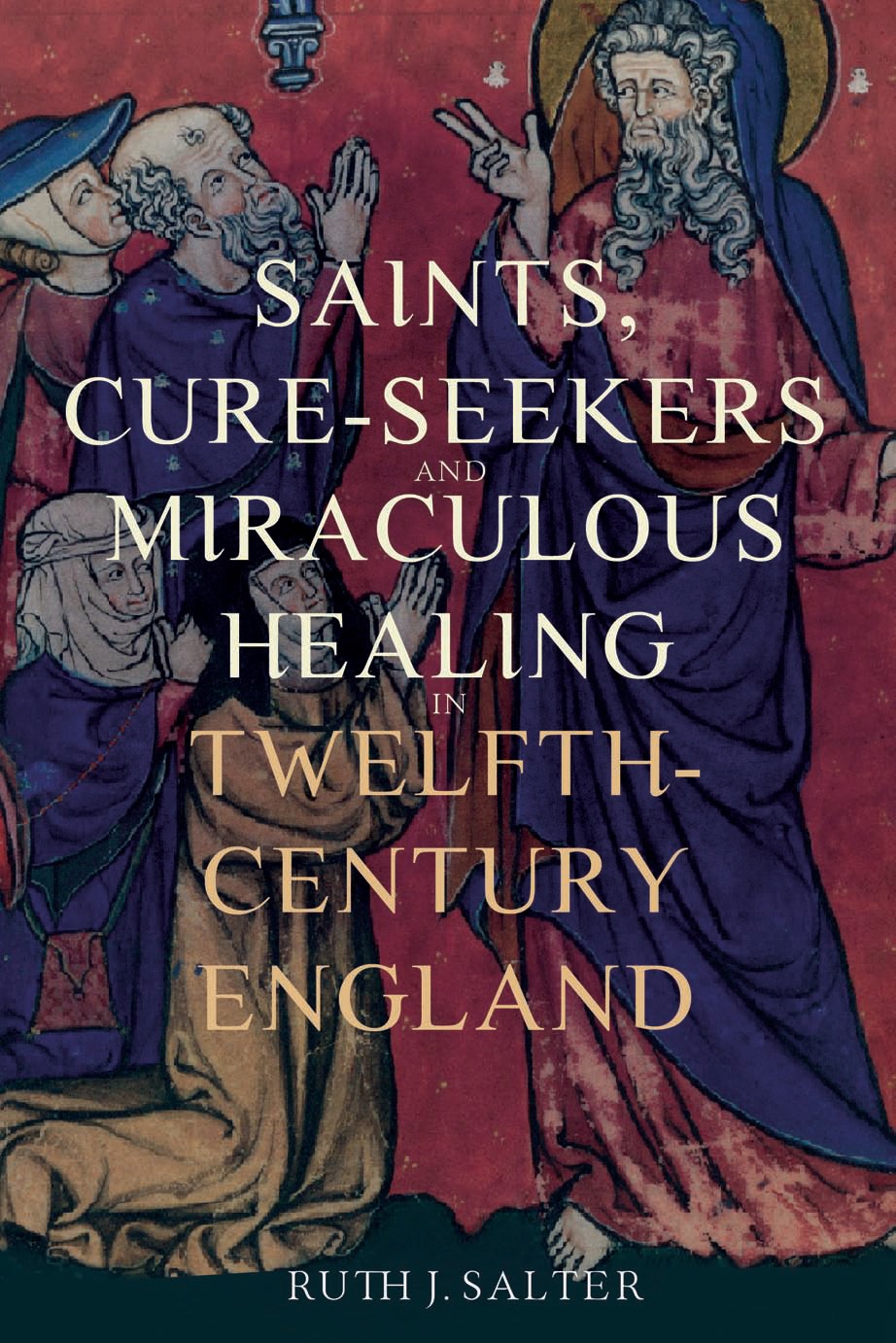
    I might have been a way for a while, but I’ve not been idle during that time and I’m excited to now be able to reveal the cover for Saints, Cure-Seekers and Miraculous Healing in Twelfth-Century England which will be published this summer with York Medieval Press and Boydell & Brewer. This will be one of the first publications to come out in the new YMP series Health and Healing in the Middle Ages (editors Peregrine Horden and Linda E. Voigts).

    It is fair to say that in many ways this book has been a long time in the making, and the process isn’t quite over yet (hello indexing, copy editing etc.!) But seeing the cover makes it feel all the more ‘real’ now which, in the current circumstances, is just such a joy.

    Further details about Saints, Cure-Seekers and Miraculous Healing in Twelfth-Century England can be found via the Boydell & Brewer website.

    Image
  • Monday 14th December 1914: Bad Weather in the Bay of Biscay

    Last year I shared three December entries from my great-grandfather’s War Time Signal Log on the Reading History blog.[*]  Having come to a bit of a creative block with my writing this afternoon, I thought I would take a break from medieval medicine and return to the pages of Arthur John Pidgeon’s Log to see what he was up to on this day in 1914.

    Arthur was a Petty Officer (1st class) in the merchant navy.  During 1914 he was stationed on HMS Talbot, and one of their main duties was patrolling the Channel.  My family are fortunate enough to still have Arthur’s Log in which he recorded the events of just over a year (1st August 1914 to 22nd August 1915).


    This slideshow requires JavaScript.

    The Log is beautifully written in ink, with an entry for each day, and stands as a very personal record of one person, and one ship’s, experience of the first year of World War One.  And while there are references to greater events going on beyond the HMS Talbot, there are also snippets of everyday life at sea.  Below I provide a photo of the original log, and the transcript, for December 14th’s entry: a day when HMS Talbot encountered bad weather in the Bay of Biscay.  For the most part, this entry is beautifully written although you might note a few slight oddities in wording here and there.

    14th December 1914 - lightened

    The weather was very rough again & we were still steaming about slow waiting for the other transport to join us up.  We shaped our course early in the morning across the Bay of Biscay but we were a good thirty miles out of the track of the steamers.  At 2.0 p.m. The other transport picked us up & then we proceeded at 11 knots.  The weather was very rough in the Bay & things were rolling about the deck again & a few more pieces of crockery was broken & the transports that was now in single line ahead were rolling heavily & not keeping very good station.  Their names were “Drumera” “Jonian” “Saturnia” “Aragon” “Caledonia” “Nile”.  The men on board being mostly Territorials must have been sea-sick on their first voyage out.  The weather kept bad all day but we passed a few ships on their way home.

    ____________________

    [*] Last year’s posts:

    3rd December 1914: Rough weather at sea and the ship’s cat

    13th December 1914: Bad apples and a mishap in the kitchen

    25th December 1914: Christmas Day on board HMS Talbot


  • My research focuses particularly on the experiences of pilgrims who sought out miraculous cures from saint cults in high-medieval England.  A key resource for this, therefore, are the hagiographical sources which include reports of the posthumous miracles (collected together in a subgenre called miracula) worked by various saints through their shrines.  However, these formally written-up texts were not produced for all saints’ cults, and even when they were, not all survive.  One saint’s cult that we know drew in pilgrims was that of St Robert of Knaresborough (d. 1218).  Yet, while some hagiographical evidence survives for the saint, the focus of most writings on St Robert are focused towards his vita (life) with only passing mentions of what happened following his death. (more…)

  • The Maladies, Miracles and Medicine of the Middle Ages, II: Places, Spaces and Objects (23rd March 2018)

    Image for blog

    My co-organiser, Frances Cook, and I are pleased to announce that we can now share our programme for the sixth annual GCMS (Graduate Centre for Medieval Studies) postgraduate and early-career researcher conference.

    Further details including the programme can be found below.

    (more…)